

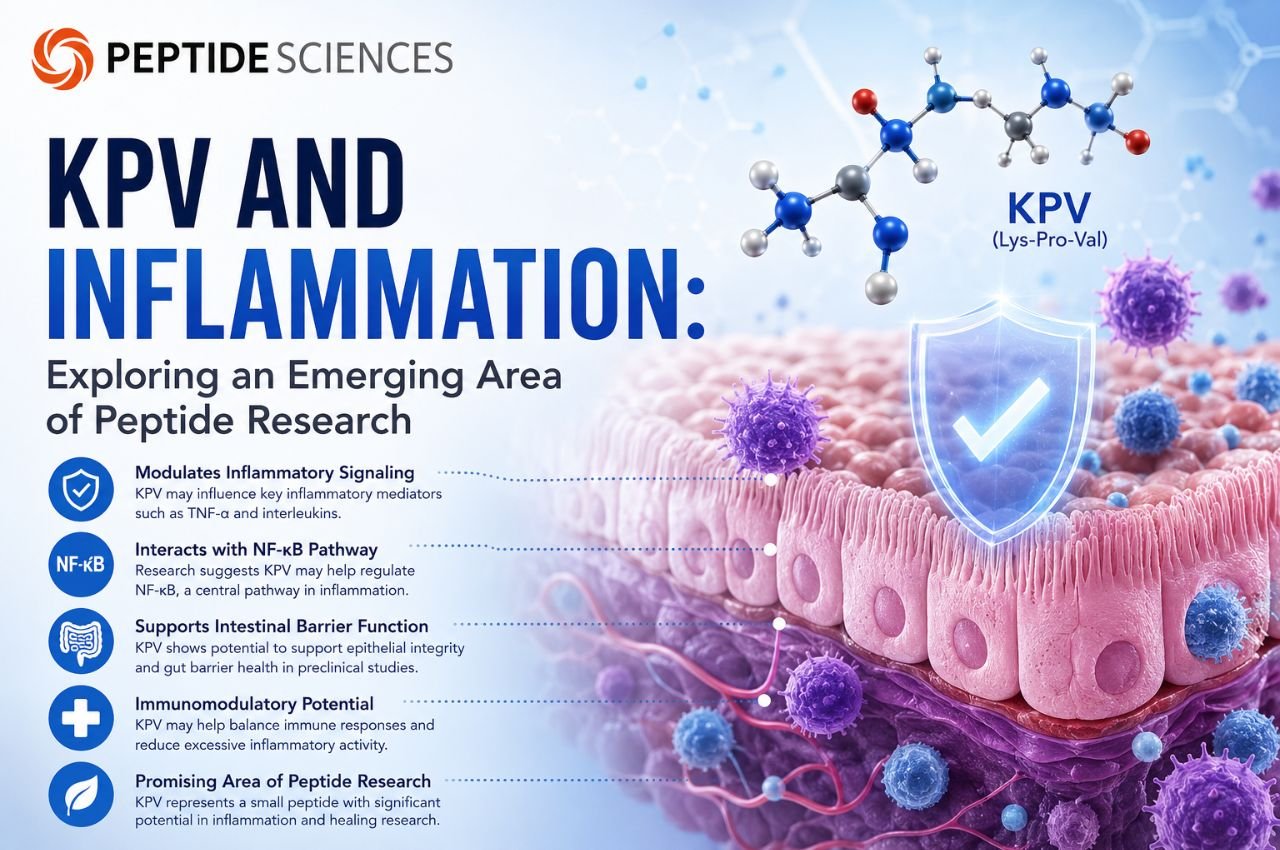
Inflammation is one of the body’s most important biological defense mechanisms. It helps organisms respond to injury, infection, cellular stress, and harmful stimuli. Yet when inflammatory signaling becomes excessive, persistent, or poorly regulated, it may contribute to tissue damage and numerous chronic disease processes.
This complex relationship has made inflammation one of the most actively studied areas of modern biomedical science. Among the many compounds attracting scientific interest is KPV, a remarkably small peptide composed of just three amino acids: lysine, proline, and valine.
Despite its simple structure, the KPV peptide has become an emerging subject of research involving inflammatory signaling, cytokine regulation, intestinal biology, epithelial tissues, immune responses, and wound-related processes.
KPV is particularly interesting because it is derived from the C-terminal sequence of alpha-melanocyte-stimulating hormone, or α-MSH, a naturally occurring peptide with recognized roles in pigmentation and inflammatory regulation. Understanding KPV may therefore provide researchers with valuable insight into how very small peptide sequences can influence complex biological pathways.
What Exactly Is the KPV Peptide?
KPV is a tripeptide consisting of the amino acid sequence Lys-Pro-Val. It represents the final three amino acids of α-MSH.
Alpha-melanocyte-stimulating hormone belongs to the melanocortin family and is derived from a larger precursor protein called proopiomelanocortin, commonly abbreviated as POMC.
Although α-MSH is widely recognized for its role in pigmentation, scientists have also investigated its anti-inflammatory and immunomodulatory properties.
KPV appears to retain certain inflammation-related properties associated with the parent molecule despite consisting of only three amino acids. This has made it scientifically interesting as researchers attempt to understand which parts of larger peptide molecules are responsible for particular biological effects.
Rather than studying the entire α-MSH molecule, scientists can examine KPV to investigate whether this short sequence contributes independently to specific aspects of inflammatory regulation.
Why Is Inflammation So Important to Research?
Inflammation is not inherently harmful. Acute inflammation is essential to survival.
When tissue is injured or exposed to pathogens, immune cells release signaling molecules that help coordinate defense and repair. Blood flow may increase, immune cells migrate toward affected tissues, and various cytokines help organize the response.
Problems may arise when inflammation becomes chronic.
Persistent inflammatory signaling has been investigated in relation to gastrointestinal disorders, metabolic dysfunction, cardiovascular disease, autoimmune conditions, neurodegenerative processes, and other chronic health problems.
Researchers therefore seek to understand how inflammation can be appropriately regulated without interfering with the protective functions of the immune system.
KPV has attracted attention because preclinical studies suggest it may interact with some of the molecular pathways involved in inflammatory responses.
KPV and Pro-Inflammatory Cytokines
Cytokines are small signaling proteins that allow immune cells and other tissues to communicate.
Some cytokines promote inflammatory activity, while others contribute to limiting or resolving inflammation. Maintaining an appropriate balance between these signals is essential to normal immune function.
Research involving KPV has examined its potential relationship with pro-inflammatory mediators such as tumor necrosis factor-alpha, commonly known as TNF-α, and certain interleukins.
Scientists are interested in whether KPV may influence the production or activity of inflammatory mediators under specific experimental conditions.
This does not mean that KPV simply “switches off” inflammation. Biological inflammatory responses are far more complex and involve interconnected signaling networks, immune cells, receptors, transcription factors, and environmental conditions.
The more scientifically relevant question is how KPV may influence specific pathways within this larger network.
The NF-κB Pathway and Inflammatory Signaling
One particularly important area of inflammation research involves nuclear factor kappa B, commonly abbreviated as NF-κB.
NF-κB is a family of transcription factors that plays a central role in regulating genes involved in inflammation, immune responses, cellular survival, and stress.
When activated by particular stimuli, NF-κB can enter the cell nucleus and influence the expression of inflammatory genes.
Excessive or persistent activation of this pathway is associated with various chronic inflammatory conditions, making it a major target of biomedical research.
Experimental studies have investigated whether KPV can influence NF-κB-related signaling under certain conditions. This potential interaction is one reason the peptide has generated interest in research involving inflammatory regulation.
However, molecular mechanisms can vary considerably between cell types, tissues, experimental models, concentrations, and study conditions. Results should therefore be interpreted within the specific context in which they were observed.
KPV and Intestinal Research
One of the most interesting areas of KPV research involves the gastrointestinal system.
The intestinal lining has a challenging biological role. It must allow nutrients to be absorbed while simultaneously maintaining a barrier against potentially harmful microorganisms, toxins, and other environmental substances.
This barrier consists largely of epithelial cells joined together through specialized structures. It also interacts continuously with immune cells and the enormous community of microorganisms known as the gut microbiome.
When intestinal barrier function or immune regulation becomes disrupted, inflammatory processes may develop.
Researchers have investigated KPV in experimental models involving intestinal inflammation, epithelial cells, and inflammatory signaling. This has generated interest in its potential relevance to the study of inflammatory bowel conditions and intestinal barrier biology.
Nevertheless, experimental findings should not be interpreted as proof that KPV is an established treatment for gastrointestinal diseases.
Epithelial Tissues and Barrier Function
KPV research extends beyond the gastrointestinal tract because epithelial tissues are found throughout the body.
Epithelial cells form protective barriers covering external surfaces and lining internal organs. They are present in the skin, respiratory system, digestive tract, and other tissues.
These barriers do much more than provide physical protection. They actively participate in immune surveillance, inflammatory signaling, antimicrobial defense, and tissue repair.
Because KPV has been studied in relation to epithelial biology and inflammation, researchers are interested in how it may influence cellular responses at these important biological interfaces.
Understanding peptide signaling in epithelial tissues could potentially contribute to broader research into inflammation, wound repair, barrier integrity, and immune communication.
KPV, Skin, and Wound-Related Research
The skin is both the body’s largest organ and an important immune barrier.
When skin is damaged, healing requires coordinated interactions between inflammation, immune cells, fibroblasts, blood vessels, collagen, and epithelial cells.
Because KPV is associated with inflammatory regulation, scientists have explored its potential relevance to skin and wound-related research.
The relationship between inflammation and healing is particularly complex. Too little inflammation may impair defense and early repair, while excessive or prolonged inflammation can potentially delay normal tissue recovery.
This makes compounds that influence inflammatory signaling scientifically interesting to researchers studying the balance between immune activation and tissue repair.
How Does KPV Differ From Other Healing Peptides?
KPV is often grouped with healing peptides, but its primary research focus differs from compounds such as BPC-157, TB-500, and GHK-Cu.
BPC-157 is widely investigated in preclinical models involving tissue repair, vascular signaling, and gastrointestinal protection. TB-500-related research emphasizes cellular migration, actin regulation, and wound healing. GHK-Cu is strongly associated with collagen production, extracellular matrix remodeling, and skin regeneration.
KPV is particularly notable for its relationship with inflammatory signaling, epithelial tissues, and immune regulation.
These differences demonstrate why peptides within the same broad category should not be considered interchangeable.
Research Limitations and the Importance of Quality
Despite growing interest in KPV, much of the available evidence remains preclinical. Results from cell cultures and animal models cannot automatically establish human safety or effectiveness.
Researchers should also consider the quality of the actual compound being studied. Incorrect molecular identity, impurities, degradation, or inappropriate storage can compromise experimental results.
Analytical documentation such as Certificates of Analysis, HPLC data, Mass Spectrometry results, and batch information may help evaluate research material quality.
Reliable science depends on both rigorous experimental design and properly characterized compounds.
The Future of KPV Research
KPV represents a fascinating example of how a molecule containing only three amino acids can become relevant to complex questions about inflammation and cellular communication.
Future research may further clarify its interactions with cytokines, NF-κB signaling, intestinal tissues, epithelial barriers, immune responses, and wound-related processes.
The scientific importance of KPV lies not in exaggerated promises but in the questions it helps researchers investigate: How is inflammation regulated? How do epithelial cells communicate with the immune system? And can small peptide sequences reveal new mechanisms involved in maintaining biological balance?
As inflammation research continues to evolve, KPV is likely to remain an intriguing compound in the wider scientific exploration of immune signaling, tissue biology, and cellular regulation.