

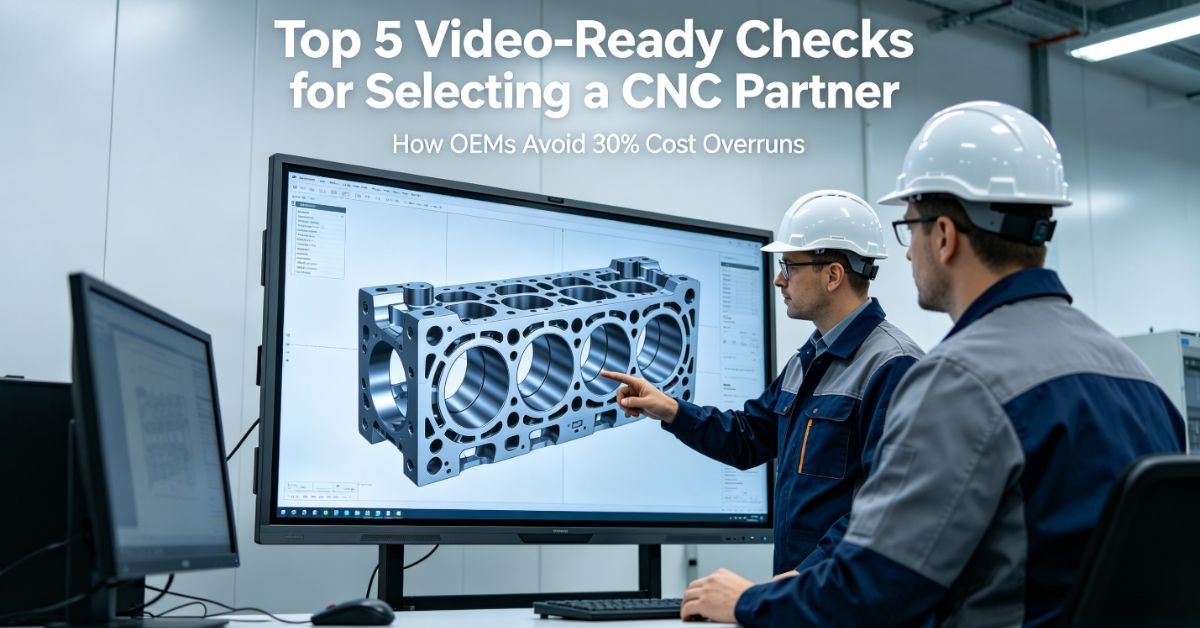
Introduction
Original Equipment Manufacturers (OEMs) encounter significant problems when choosing CNC machine shops. This includes issues such as non-transparent quoting procedures, slow delivery of products and poor quality, resulting in an average overrun of costs by 30% per project. Such occurrences negatively impact product launch times and reduce profit margins.
These problems arise from a lack of comprehensive evaluation of suppliers’ capabilities in terms of their technical abilities, flexible quality control mechanisms, and ability to produce in large volumes. The focus on prices alone without a proper evaluation system makes it difficult to identify suppliers with mature manufacturing capabilities in addition to sophisticated manufacturing equipment. The current paper proposes a five-dimensional evaluation procedure aimed at evaluating process transparency and Total Cost of Ownership (TCO) benefits of prospective suppliers using video audit procedures.
How Can Technical Capability and Process Transparency Be Verified Beyond Machine Lists?
From equipment lists to verifying problem-solving capability in reality. Needing proof of superior process controls and material knowledge. Matching the technical capability of suppliers to ASME Y14.5 geometric tolerancing standards.
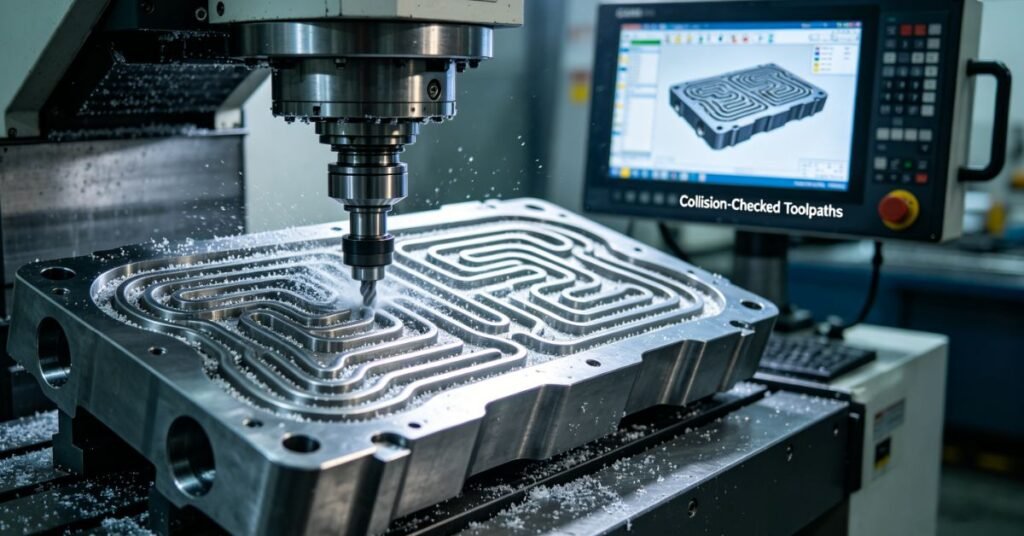
1. Verifying Process Documentation by Video Audits
Technical capability verification requires more than listing machines; it involves reviewing process documentation such as videos that illustrate processes, including collision-checked toolpaths on CAM software simulations. The ability to shift from 3-axis machining to 5-axis CNC machining for undercuts is indicative of process knowledge. In advanced CNC machining manufacturing case studies, suppliers have managed to solve issues such as preventing delamination in machining carbon fiber composite parts, requiring special fixturing techniques and diamond-coated cutting tools, which lowered scrap rates by 22%.
2. Process Knowledge and Tolerancing Proficiency
The supplier must demonstrate process expertise based on material properties, like the work hardening process involved with titanium machining. Applying ASME Y14.5 standards guarantees geometric tolerancing is respected, especially for audits of supplier capacity to ensure ±0.05mm tolerance across multi-faceted surfaces. Top-quality suppliers highlight precision CNC machining services with video evidence showcasing probing of datums on machine mid-operation and avoiding accumulated error.
3. Adapting Quickly to Unusual Challenges
CNC machining process maturity is apparent from reactions to unusual situations: Does the supplier machine wall thickness down to 0.3mm on 7075 aluminum without vibration problems? Is toolpath optimization documented in machining parts with deep cavities? Videos that audit CNC machining manufacturing of rocket nozzles that have 75+ degree access angles show proficiency beyond data sheets alone.
What Defines a Genuine CNC Machining Price Quote?
Analysis of underlying cost factors going beyond the hourly price to uncover real economics of the project. Utilizing data-driven approach to manufacturing as per NIST guidelines for cost effectiveness. Distinguishing between surface level quotations and those backed by analytical considerations.
- Component Cost Pricing Approach: Transparent pricing is based on the breakdown of underlying expenses: cost of materials certification (for instance, AMS 4911 titanium), programming time for design for manufacturability (DFM) assessment, and inspection. A CNC price quotation and price strategy that fails to account for these parameters stands a chance of overlooking 15-20% additional costs associated with the manufacturing process. For example, specifying Nadcap-approved chem-film coating costs 8−12 more than anodizing per part.
- Real-Time Cost Efficiency in Data Management: Real-time cost efficiency in manufacturing processes is a feature emphasized by NIST. Predictive modeling tools of tool-wear can be quoted from suppliers in NIST’s trustworthy systems. The cost will be higher, but they ensure a 12% TCO reduction due to zero tolerance for wastage. Compare this with the $75/hr machining quoted by suppliers not utilizing DFM inputs.
- Risk-Adjusted Pricing for Complex Geometries: There are various risks involved in complex shapes when obtaining quotes from OEM Parts CNC Manufacturer. Deep geometries require long cutting tools, leading to increased cycle times by 30-40%. Flat geometries require tight tolerance values, e.g., ≤0.1 mm, thus lapping must occur. A supplier’s quote and pricing of CNC machining will indicate any sensitivity analysis, e.g., bore tolerances can be expanded from ±0.025mm to ±0.05mm, reducing cost by 18%.
Is the Supplier’s Quality System a Fixed Certificate or an Evolving System?
The difference between documentation and quality culture. Confirmation of AS9100D/IATF 16949 certification standards by process performance indicators. The relationship between certification rigidity and successful deployment across industries.
1. Implementing Standards in Regulated Industries
For quality management in CNC machining, more than just ISO 9001 certification is needed: Documentation of SPC and FAIR with MSA certification is required. For custom CNC machining in the aerospace industry, it is essential that the supplier be able to demonstrate AS9100D compliant material traceability using video footage of barcoded alloy certificates matching serial numbers. ISO 9001 certified CNC machining becomes meaningful if the audit reveals quarantined non-conforming material with 8D report.
2. Technology-assisted Verification Process Flows
The ISO 9001 accredited CNC machining is backed by video documentation of coordinate measuring machine (CMM) autofocus calibration or inline laser scanning confirming profile tolerance. Multi-industry CNC machining providers must exhibit compliance with IATF 16949’s process audits — such as reviewing fixture wear after every 50 runs — and have digital documentation available for their clients’ view. Proof that process auditing is real can be found here!
3. The Loop of Continuous Improvement
IATF 16949 and AS9100D require the implementation of corrective action procedures, as done by LS which is certified to ISO 14001, ISO 9001, IATF 16949, AS9100D, and utilizes quality control principles in its CNC machining process. With video documentation, it can be demonstrated how CMM issues necessitate tool offsets within fifteen minutes — demonstrating that process improvements are in action, not just certificates on a wall!
How can a supplier avoid gaps in scalability from prototype to production?
Preventing scalability gaps through standardized knowledge transfers. Ensuring consistency in DFM methodologies across different stages of development. Utilizing scalable process controls right from the early builds.
1. Prototype as Production Process Development Approach
Excellence among CNC Machining Supplier can only be attained where prototype processes lock down machining datums, tooling approaches, and inspection practices that ensure scalability during high volumes. Where suppliers regard low-volume production of CNC Machining services as scaled-down production processes utilizing the same cutting data and fixtures do not experience 40 percent declines in yields during scalability. Multi-industry video audit for CNC Machining should capture PFMEA for prototypes.
2. Linking DFM Continuity Through Phases
Low volume production CNC machining works when DFM learnings gleaned through analysis of prototypes are used to optimize tool access angles/wall thicknesses prior to building tooling for production. A prime example is changing the rib placement on a housing for medical equipment to prevent 5-axis collisions, which were noted in transition meetings of the CNC machining supplier, avoiding $28,000 of retooling expense further down the road. This calls for PLM systems that link prototype data with ERP.
3. Deploying Quality Systems That Scale
CNC Machining Supplier capability also involves implementation of multi-industry CNC machining application-specific quality assurance programs, with full CMM inspection of aerospace hardware as opposed to statistical sampling of consumer products. Visual confirmation of a low volume production CNC machining line must include serialization of product numbers along with real-time SPC monitoring regardless of batch size, whether 10 parts or 10,000.
What Should a Due Diligence Checklist Include for a Reliable Partnership?
Combining audit categories into tangible supplier assessment protocol. Focusing on factual verification rather than marketing promises. Setting minimum requirements for online CNC machining manufacturers.
- Technical Case Study Investigation: Assess online CNC machining suppliers through video demonstrations of case studies involving intricate parts and focusing on how they machined components such as 0.4mm micro-slots in hardened steel. Confirm CNC machining manufacturing issues tackled: Was it done through EDM machining? What tolerance levels were maintained? Compare their capabilities to those stated in ASME Y14.5 inspection documents.
- Quality Management Traceability Test: Necessitate online CNC machining manufacturing companies to demonstrate quality management capability in CNC machining process system: Can they trace the certificate of raw material, FAIR, and CMM of a 2022 aerospace part in less than 3 minutes? Manufacturers holding ISO 9001 certification in CNC machining must prove their connectivity of digital thread from PO through to delivery. An inability to do so is an indicator of no process integration of IATF 16949/AS9100D.
- Engineering Cooperation Stress Test: The selection process of CNC machining manufacturer depends on the level of communication efficiency. Conduct an engineering modification test, asking: “Is it possible to decrease the pocket depth from 5mm to 4.5mm, along with a new CNC machining quotation and prices offered in 2 hours?” High-quality CNC machining suppliers will make use of CAM templates and DFM analysis automation capability to prove cooperation agility.
Conclusion
Picking a CNC machining provider represents a high-tech business decision that must be carefully analyzed based on proven evidence of transparency, costing rationale, dynamism in quality systems, and process scaling. With this five-fold auditing method, which focuses on visual verification over marketing pitches, OEMs reduce the risk of up to 30% cost overruns, thus ensuring their suppliers have the necessary CNC machining production capabilities for design-to-market transition. Such an approach shifts purchasing from transactions into partnership design.
FAQS
Q: What is the biggest mistake companies can make when considering a CNC machining partner?
A: Considering the lowest unit cost at all costs will prove to be one of the most expensive mistakes, since it may end up costing a company money due to delays caused by poor quality issues. Looking beyond the unit cost to Total Cost of Ownership (TCO) can avoid this costly mistake.
Q: How critical are certifications like ISO 9001 in evaluating suppliers?
A: While certifications offer minimum standards, execution is what really matters. Find out how issues are documented with root cause analysis tools such as 8D and incorporated into instructions. In some industries, it becomes mandatory that IATF 16949 (automotive) or AS9100D (aerospace) are adhered to, providing traceability and safety measures more than ISO 9001 can.
Q: Does one supplier suffice for both prototyping and high-scale production?
A: Indeed, but only if there is process design recognizing prototypes as “production process development.” This involves ensuring that any machining, datum tooling, and DFM improvements are finalized during the pilot stages. Failure to do this means that the yield at scale-up drops by 35%+.
Q: How long does it take for a complicated CNC machined part?
A: Medium complexity takes about 4-6 weeks after the drawings are frozen, provided suppliers are prepared. High complexity pieces that need 5-axis machining and rigorous inspection take 6-10 weeks. Good partners offer a Gantt chart with timelines covering DFM analysis, sourcing, machining, and inspections.
Q: What do I need to do to optimize the manufacturing process before getting the quote?
A: Get a Design for Manufacture (DFM) analysis done early by giving your CAD files to suppliers. Their engineers will locate issues with tool access, thin walls, or tolerances which are responsible for high costs. DFM will help them figure out and suggest changes to ease the manufacturing process.
Author Bio
The author is an employee at LS Manufacturing, a global company that gives precision CNC machining services mainly to OEM clients in aerospace, medical, and automotive sectors. The company is certified with ISO 14001, ISO 9001, IATF 16949, and AS9100D. It boasts a comprehensive knowledge base for transforming complex designs into production items using a data-driven quality system. If you’re interested in a DFM evaluation plus getting competitive quotes, just share your design files with them today!



Pingback: Best Power Bank in Pakistan: How to Choose the Right Portable Charger for Everyday Use