

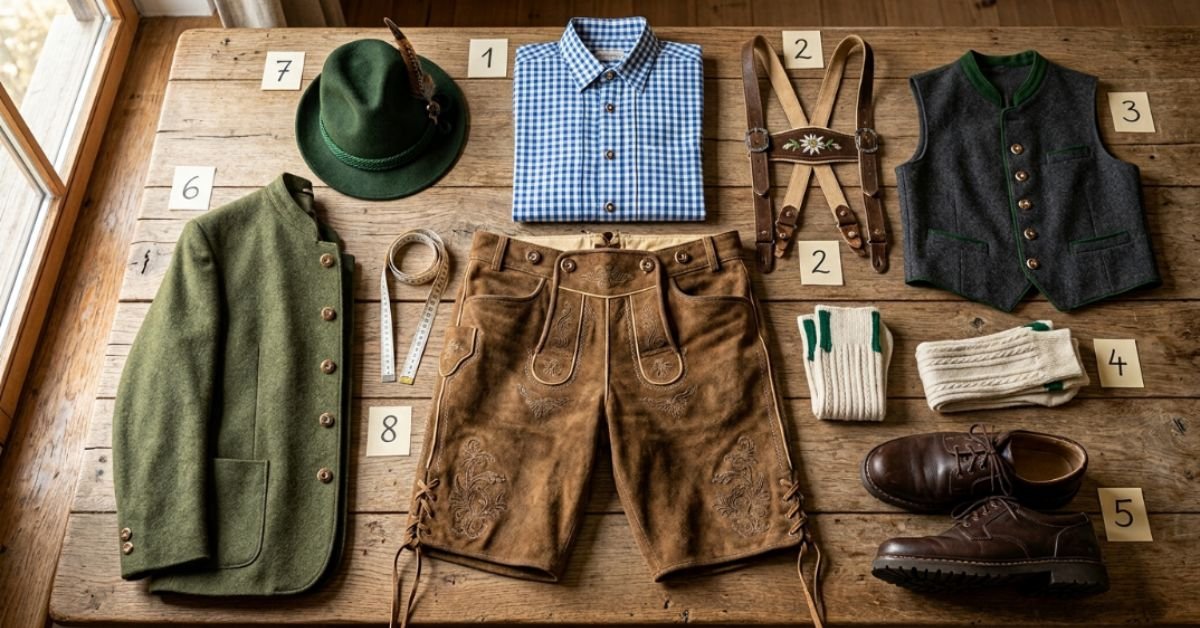
Great traditional outfits aren’t chosen — they’re assembled, and the assembly has a manual. The oktoberfest mens outfit is a specified system: five core pieces with exact roles, three optional upgrades with exact registers, an assembly order the tradition wrote, and coordination rules that make the whole read as one deliberate build rather than five purchases sharing a body. This guide is the manual in full — each piece specified to buying detail, the palette logic that ties them, the morning assembly sequence, the upgrade path from first festival to full wardrobe, and the checklist that catches every gap before the tent does.
Piece One: The Lederhosen — The Foundation
Everything builds on the leather. Specification: genuine hide (suede cowhide at the accessible tier, deerskin at the premium), classic short cut (hem at or above the knee) or knee-length for the more formal line, in tan through dark brown, with button-front construction, side or rear lacing, and sewn suspender buttons. Fit: snug at the natural waist and seat by measurement — the hide molds to custom across the first wears — with a few home evenings of break-in before the festival. The foundation decision sets the outfit’s palette: every piece after coordinates to the leather’s tone.
Pieces Two and Three: Shirt and Suspenders — The Visible Architecture
The shirt: woven cotton Trachtenhemd — blue-and-white medium gingham as the classic, red or green check as legitimate alternates, solid white for the dressed register — cut with tuck-depth that survives raised arms, because tucked is the law. The suspenders: the traditional H-bar — leather straps, decorated crossbar, button attachment — worn over the shirt with the crossbar at mid-chest, tension carrying the trousers at natural waist. Together they’re the outfit’s visible architecture: the check and the crossbar occupy the torso’s focal zone, and their quality (woven pattern on both fabric faces, stitched crossbar embroidery) is what every close look reads first.
Pieces Four and Five: Socks and Shoes — The Ground Game
The socks: wool knee socks in cream (the universal), grey or loden green — folded once below the knee — or the two-piece Loferl for the connoisseur signal; real wool with gripping ribbed cuffs, never athletic tubes. The shoes: sturdy leather in the Haferl tradition or plain leather boots, dark brown or black, built for ten standing hours; the clean-minimal-sneaker liberty exists at casual festivals but never beneath wool knee socks. The ground game matters beyond looks: the festival day is a standing marathon, and the traditional footwear system was engineered for exactly it.
The Upgrades: Vest, Jacket, Hat
Three additions scale the oktoberfest male attire system by register. The vest (Gilet): wool or loden over the shirt — suspenders beneath or omitted — moving the build from festival-standard to elevated; grey or loden green over brown leather is the canonical pairing. The Janker jacket: the traditional wool coat completing formal register and rescuing cold evenings — charcoal or loden, worn open in the tents. The hat: genuine felt with cord, feather or pins, in loden green or grey — the finishing move that completes the silhouette from the top. The buying order is the wearing order: core five first, vest second, Janker and hat as occasions and autumn arrive.
Palette, Assembly and the Pre-Tent Checklist
The coordination logic is one rule applied everywhere: the leather leads, and everything harmonizes to it — matching-or-deeper suspender tone, check colors echoing once elsewhere (sock flash, hat cord), cream as the universal connector, and the green thread (loden vest, hat, sock flashes) lighting two or three points, never all. The morning assembly runs the traditional order: socks, trousers, tucked shirt, suspenders set at mid-chest, shoes — then vest, jacket, hat by register — five minutes, holding twelve hours.
The pre-tent checklist catches the classic gaps: shirt tucked fully; rear suspender buttons seated (the bench-dancing load point); socks folded at height, no branding; cash and phone in the trouser pockets, nothing that shouldn’t dance; and the outfit adjusted once, then lived in — the fluency signal the whole tent reads.
The Build Across Seasons
The system’s last virtue is its upgrade economics. Season one: the accessible-tier core five, ordered weeks ahead of the sellout, worn complete. Season two: the second shirt (rotation for multi-day festivals) and the vest. Season three onward: the Janker, the hat with its growing pin collection, and — when the habit has earned it — the premium-hide lederhosen upgrade, with the original pair graduating to relaxed-register duty. Every piece transfers across every future build; nothing bought correctly is ever bought again. That staged path is precisely how the tents’ best-dressed men assembled what they’re wearing — one correct piece per season, coordinated by the same palette rule from the first festival to the fifteenth.
Frequently Asked Questions
What are the five core pieces of the men’s Oktoberfest outfit?
Genuine lederhosen, a woven checked or white shirt (tucked), H-bar suspenders, wool knee socks, and sturdy leather shoes — the complete festival-standard system.
What order do the pieces go on?
Socks, trousers, tucked shirt, suspenders, shoes — then vest, jacket and hat by register. Each layer locks the one beneath.
Which shirt color should the first outfit use?
Blue-and-white medium gingham — the civic classic, correct everywhere — with white as the dressed alternate and red or green as legitimate variety.
When do the vest, jacket and hat join?
By register and season: the vest elevates the standard build, the Janker carries formality and cold evenings, the hat finishes the silhouette — bought in that order after the core five.
How does the palette coordination work?
The leather leads: suspenders in its tone family, checks echoed once, cream connecting, and the green thread lit at two or three points — never all.
What’s the smartest multi-season buying path?
Core five first, then second shirt and vest, then Janker and hat, then the premium lederhosen upgrade — every piece transferring to every future build.