

On the morning of 11 September 1297, an English army stood on the south bank of the River Forth at Stirling and looked at a bridge.
It was a timber bridge, long and narrow, just wide enough for two horsemen to ride across side by side. Beyond it a causeway ran for nearly a mile across soft, boggy meadows held in a great loop of the river, and beyond the meadows rose a steep wooded crag. On the crag, in plain view, was an army of Scots, mostly spearmen on foot, commanded by two young men of no great rank. One was a northern nobleman called Andrew Murray. The other was the younger son of a minor Lowland knight. His name was William Wallace. No tartan of his survives, if he ever had one; his name is carried now by the loud red Wallace and its quiet brother, the Wallace Hunting tartan.
The English commander was the Earl of Surrey, an old soldier who had beaten the Scots before and held them in contempt. One of his officers, a Scottish knight in English service, pointed out that the bridge was a death trap and begged to be allowed to take the cavalry round by a ford upstream. He was overruled. Hugh Cressingham, King Edward’s hated treasurer in Scotland, a fat and impatient man, said they had wasted enough of the King’s money already. They would go over the bridge.
Two by two
It took all morning. The knights rode across in pairs, and then the infantry followed, and they formed up on the causeway on the far side with the river bending round behind them on three sides. On the crag, the Scots watched, and did nothing at all.
That was Wallace’s genius that day. He waited. He let the vanguard come over, several thousand of the best troops in the English army. He waited until as many were across as he thought his men could beat. Then a horn sounded, and the spearmen came down the hill at a run.
One body of them went straight for the northern end of the bridge and seized it. From that moment the battle was over, although the killing had hardly begun. The English on the north bank could not get back, and the English on the south bank could not get across to help them. The heavy cavalry floundered in the wet meadow. The Scottish spears pushed them steadily back into the loop of the river, and those who were not speared were drowned in their armour. Surrey, who had never crossed, watched half his army die in front of him, had the bridge broken down, and rode for the Border without stopping.
Cressingham was among the dead. He was so detested that, according to an English chronicler, the Scots flayed his body and divided the skin as trophies, and it was said that Wallace had a strip of it made into a belt for his sword. It may even be true. The thirteenth century was not a gentle time.
The man and the myth
Wallace was made Guardian of Scotland. His triumph lasted ten months. In July 1298 King Edward came north in person and destroyed the Scottish army at Falkirk with his Welsh longbowmen. Wallace resigned the guardianship, spent years abroad seeking help from France and the Pope, came home, was betrayed near Glasgow in August 1305, and was taken to London. He was tried in Westminster Hall for treason, to which he replied that he could not be a traitor to a king he had never sworn allegiance to. He was hanged, drawn and quartered at Smithfield the same day.
Seven hundred years later most of the world knows him from a film, and the film, whatever its merits, got almost nothing right about how he looked.
William Wallace did not wear a kilt. The kilt, even in its earliest belted form, was not worn anywhere for another three hundred years, and when it was, it was worn by Gaelic-speaking Highlanders. Wallace was a Lowlander from the south-west. His very name means Welshman, a speaker of the old British tongue of Strathclyde. He would have gone into battle in a padded jacket, a mail shirt if he could afford one, and an iron cap. He did not paint his face blue. That was the custom of the ancient Picts, a thousand years earlier. He had no tartan, and neither did anyone else in his army.
None of this makes him smaller. The real man, who out-thought a professional army with a rabble of farmers on foot, is a good deal more impressive than the screen version.
The tartan he never saw
The Wallace tartan first appeared in 1842 in the Vestiarium Scoticum, the splendid and spurious book that supplied tartans to so many Lowland families who lacked one. The name of Wallace was by then so honoured that the pattern was taken up at once. It is one of the simplest tartans in existence, a bold check of red and black with a single fine yellow line, and one of the most popular in the world.
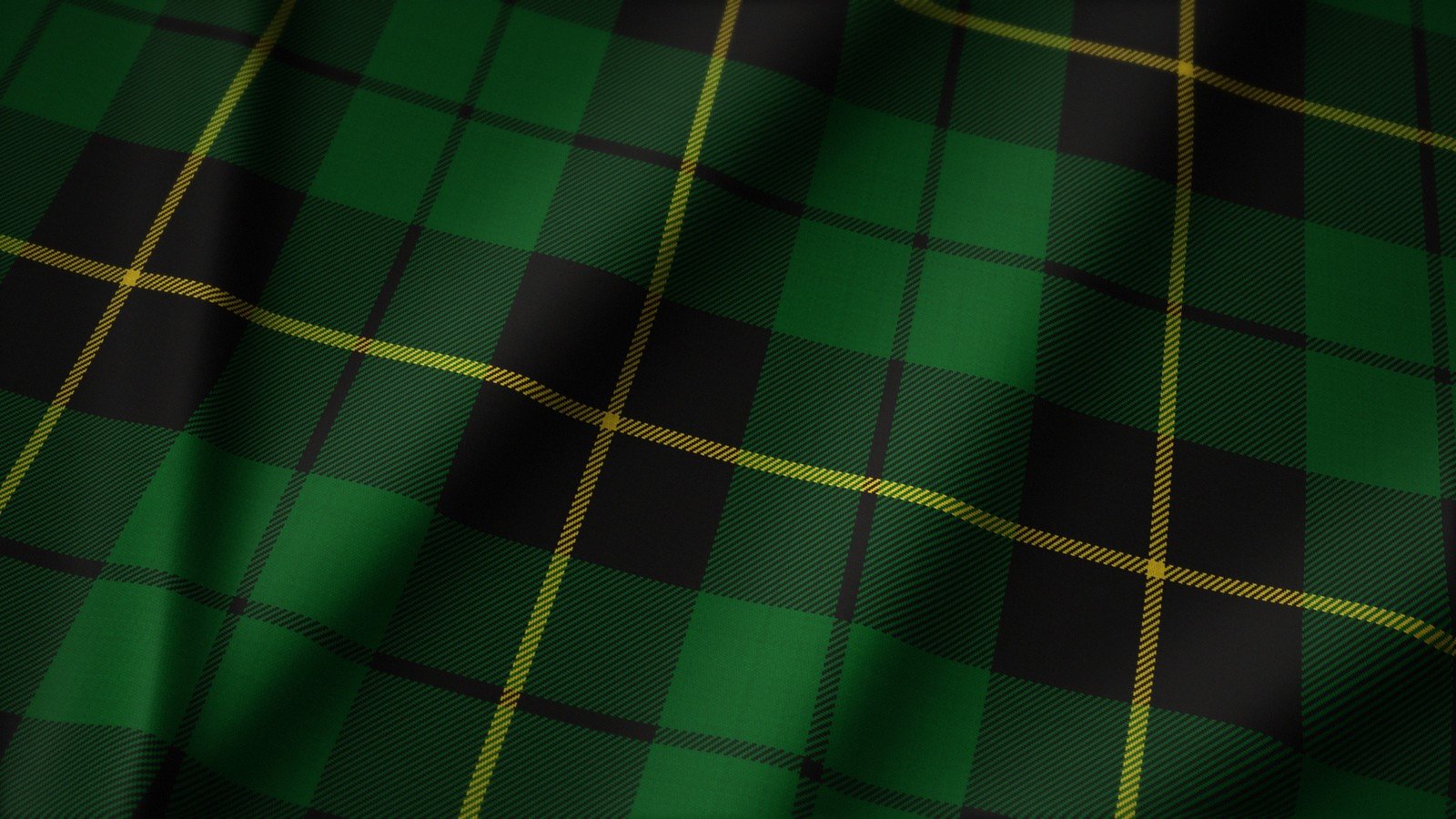
The hunting version came much later. The Scottish tartan registers record it from a sample woven by the Lochcarron mill around 1980, and describe it in seven words: as the Wallace, “but with green replacing the red.” That is all it is. Broad squares of deep green and black, the same fine yellow line. It is the quiet brother of a loud tartan, dark and handsome, and it looks well on everybody. It is also the easiest Wallace to dress, because it takes accessories for kilts in silver, pewter or leather without any argument.
Those looking for Wallace Hunting tartan will find it listed with the red Wallace and the white-ground Dress Wallace, made to order as kilts, skirts, waistcoats and scarves, or sold by the yard. It has become a particular favourite for weddings, where a groom called Wallace wants his name on his kilt without looking like an extra from a film.
Fort Worth, Texas, a Saturday in April
Travis Wallace is twenty-eight, six foot three, and is getting married in three weeks. His kilt arrived on Tuesday, eight yards of green and black with a gold line, made to his measurements. His best man’s first words on seeing it were, “Are you gonna do the face?”
He is not going to do the face. He has decided that if he is going to wear this, he is going to wear it right, and he has discovered that wearing it right is mostly a matter of small things. A kilt on its own is a skirt. What turns it into Highland dress is the set of objects that go with it, every one of which started out as a piece of practical equipment.
He bought them all in one go from Scottish Kilt, which had made the kilt and keeps its accessories for kilts together in one place: sporrans, kilt pins, belts and buckles, hose and flashes, fly plaids, brooches and ghillie brogues. Buying from one source meant the leathers matched and the metal finishes matched, which, he had read, is what separates a considered outfit from a hired one. He went through them on the bed with his fiancée, who had done the reading.
The belt first, because of Cressingham. A kilt belt is wide, two and a quarter inches or so, in black leather, with a big rectangular buckle. It does not hold the kilt up. The kilt’s own straps do that. The belt is a relic of the days when it carried a sword and a dirk, and it is worn only when there is no waistcoat, since a belt under a waistcoat makes a lump. Travis is wearing a waistcoat for the ceremony and taking it off for the dancing, so he needs one. The buckle is antique silver with a thistle.
Then the sporran, which is the pocket a kilt does not have, hung on a chain a hand’s width below the buckle. Black leather with a fur front, for a formal day wedding.
Then the kilt pin. It goes on the front apron, low down on the right-hand side, a few inches from the hem and the edge. It is pushed through the top layer of cloth only. It is there for weight, to keep the apron from flying up in a breeze, and a man who pins both aprons together will tear his kilt the first time he sits down. Travis chose one shaped like a sword. His fiancée said that was too obvious. He said he did not care.
Then the hose and flashes. Bottle-green socks, to carry the green of the kilt down the leg, turned over at the top above a garter. From the garter hang the flashes, little tabs of cloth, in gold to pick up the yellow line.
Then the knife. The sgian-dubh, the black knife, is worn tucked into the top of the right sock with only the handle showing. It began as the small blade a Highlander kept hidden in his armpit and politely moved to where his host could see it. The venue will not allow a real one, so his is a blunt dress version. Its silver cap matches the buckle, the sporran and the pin. One finish, everywhere.
Last, the shoes. Black ghillie brogues, no tongue, long laces, tied low round the ankle.
He puts it all on. His fiancée walks round him twice.
“OK,” she says. “That is not a costume. That is an outfit.”
“Every piece of it used to do something,” says Travis, looking down at himself. “The belt held a sword. The purse held your money. The pin’s a weight. The knife’s a knife. It’s like a tool belt.”
“Do not say that in your speech.”
“I’m going to open with the bridge,” says Travis. “Two by two. He just waited. That’s the whole thing. He had the nerve to wait.”
What he actually did
William Wallace never owned a tartan, a kilt, a sporran or a sgian-dubh, and would not have known what any of them were. He was a Lowland squire’s son with a sharp mind and unusual courage, who noticed that a narrow bridge and a bend in a river were worth more than a thousand knights.
The green and black cloth that carries his name is a modern compliment, paid by people who admire him. It deserves to be worn the way he fought, with attention to detail and without any fuss.