

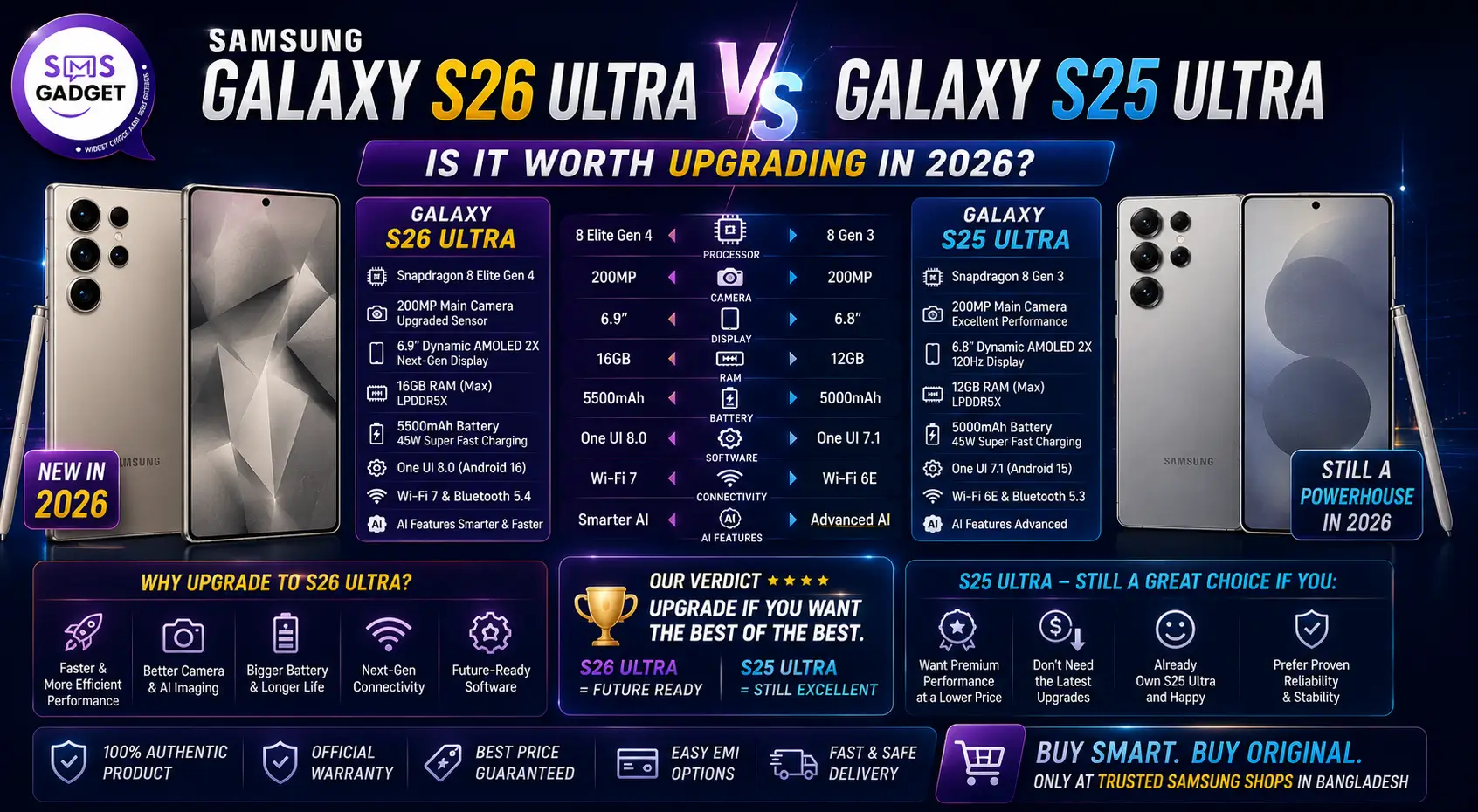
Every year, Samsung drops its flagship Ultra phone, and millions of people ask the same question: is this a real upgrade, or just a minor spec bump wrapped in new marketing? With the Galaxy S26 Ultra now officially available in Bangladesh, that question is louder than ever, especially for anyone who already owns last year’s S25 Ultra.
The honest answer is this: the Samsung Galaxy S26 Ultra is a meaningful refinement, not a revolution. Samsung did not redesign the phone from scratch. But the upgrades it brings—a significantly faster chipset, 60W fast charging that finally fixes a years-long weakness, a wider main camera aperture, and the world’s first Privacy Display on a smartphone—are real, practical improvements that users will feel in daily life.
If you are sitting on the fence about whether to buy the S26 Ultra or stick with the S25 Ultra, this is the most in-depth comparison you will find. We break down every major category—design, display, performance, cameras, battery, software, and Bangladesh pricing, so you can make the right call.
Samsung Galaxy S26 Ultra vs S25 Ultra: Quick Specs Comparison
Before we dive deep, here is a side-by-side specs table so you know exactly what changed and what stayed the same.
| Feature | Galaxy S26 Ultra | Galaxy S25 Ultra |
| Launch Year | 2026 | 2025 |
| Processor | Snapdragon 8 Elite Gen 5 (3nm) | Snapdragon 8 Elite (3nm) |
| Display | 6.9″ Dynamic AMOLED 2X, 120Hz, 2600 nits | 6.9″ Dynamic AMOLED 2X, 120Hz, 2600 nits |
| Resolution | QHD+ (1440 × 3120px) | QHD+ (1440 × 3120px) |
| Privacy Display | Yes (World’s First) | No |
| Main Camera | 200MP, f/1.4 aperture | 200MP, f/1.7 aperture |
| Ultrawide Camera | 50MP | 50MP |
| Telephoto | 10MP (3x) + 50MP (5x) | 10MP (3x) + 50MP (5x, periscope) |
| Front Camera | 12MP (AI ISP) | 12MP |
| Video | 8K @ 30fps, Horizon Lock | 8K @ 30fps |
| Battery | 5,000mAh | 5,000mAh |
| Wired Charging | 60W (Super Fast Charging 3.0 | 45W |
| Wireless Charging | 25W | 15W |
| RAM | 12GB / 16GB | 12GB / 16GB |
| Storage | 256GB / 512GB / 1TB | 256GB / 512GB / 1TB |
| Frame Material | Armor Aluminum 2 | Titanium |
| Thickness | 7.9mm | 8.2mm |
| Weight | 214g | 218g |
| S Pen | Yes (Built-in) | Yes (Built-in) |
| OS | Android 16, One UI 8.5 | Android 15, One UI 7 |
| Software Support | 7 Years | 7 Years |
| Price in Bangladesh | Tk 1,99,999 (256GB, Official) | Tk 1,50,000–৳1,60,000 (current market) |
Design — What Has Changed Between the S26 Ultra and S25 Ultra?
Design is where the S26 Ultra makes a mixed impression. Some changes are genuinely welcome. Others are controversial. Let us walk through each one.
Slimmer Body and Rounder Corners: A Noticeable Comfort Upgrade
The Galaxy S26 Ultra measures just 7.9mm in thickness — down from 8.2mm on the S25 Ultra. That is a 0.3mm reduction. On paper, that might not sound like much. But Samsung had already shocked users last year by slimming down the S25 Ultra significantly from its predecessor, and the fact that they pushed even further is impressive.
The weight has also dropped from 218 grams on the S25 Ultra to 214 grams on the S26 Ultra — a 4-gram reduction. Again, not a dramatic number, but combined with the slimmer profile, the S26 Ultra genuinely feels lighter and sleeker in hand.
The more important change, though, is the corner design. The Galaxy S25 Ultra had sharp, angular corners that gave the phone a very premium, geometric look. While some users loved that aesthetic, others found the edges uncomfortable during long sessions — holding the phone for 30+ minutes could leave marks on your palm. The S26 Ultra adopts softer, more rounded corners that align with the standard S26 and S26 Plus, creating a unified look across the Galaxy S26 family. The result is a phone that is noticeably easier to hold and more comfortable in daily use.
Camera Island: The Design Change That Divides Users
The S25 Ultra came with what Samsung called a “floating camera” design. The lenses sat nearly flush with the back panel, creating a very clean, premium look that many users praised as one of the best smartphone rear designs in recent years. The cameras felt integrated into the body rather than bolted on.
The S26 Ultra changes that. The camera island now protrudes more noticeably from the back. Samsung unified the look across the S26 series with a more prominent camera module, but the result is that the S26 Ultra actually looks less refined on the back compared to its predecessor. If you set both phones face-down on a table, the S26 Ultra will wobble more due to the elevated camera bump. This is a genuine step backward in terms of design elegance, and it is one of the most common criticisms you will find in real-world reviews.
Titanium vs Armor Aluminum 2: The Most Controversial Downgrade
This is where many loyal Samsung fans draw the line. The Galaxy S25 Ultra came with a titanium frame — the same premium material used in high-end watches, aerospace equipment, and Apple’s iPhone Pro lineup. Titanium is stronger than aluminum, lighter for its strength, and gives the phone a distinctly premium feel when you run your fingers along the edges.
The Galaxy S26 Ultra replaces that titanium frame with Armor Aluminum 2. Samsung argues this helps reduce weight and allows for a slimmer body and that Armor Aluminum 2 is still a high-quality, durable material with strong scratch resistance. But the perception problem is real: aluminum, no matter how well-engineered, does not have the same prestige or tactile quality as titanium. For a phone that costs nearly 2,00,000 in Bangladesh, this is a noticeable downgrade for buyers who value premium materials.
Design Bottom Line: The S26 Ultra is thinner, lighter, and more ergonomic than the S25 Ultra. But it sacrifices titanium for aluminum and changes a camera design that users loved. Whether those are acceptable trade-offs depends entirely on what you value most in a flagship.
Display — Same Great Screen, One Brand-New Feature
When it comes to the display itself, the S26 Ultra and S25 Ultra are essentially identical — and that is not a bad thing, because the S25 Ultra already had one of the best screens on any Android smartphone.
Screen Specifications: No Change, No Compromise
Both phones feature a 6.9-inch Dynamic AMOLED 2X panel with QHD+ resolution (1440×3120 pixels), an adaptive 120Hz refresh rate (LTPO technology, meaning it can drop to 1Hz when the screen is static to save battery), and HDR10+ support for rich colors and contrast on supported content.
Peak brightness is rated at 2,600 nits on both devices. In standardized real-world testing, both phones perform nearly identically in terms of brightness, color accuracy, and sharpness. The panels are covered by Gorilla Armor 2, which provides excellent scratch resistance and reduces reflections by up to 75%, making it significantly easier to read the screen in direct sunlight — something that matters enormously if you use your phone outdoors in Bangladesh’s bright climate.
Both phones support Samsung’s ProScaler technology, which uses AI upscaling to enhance video content quality. Side by side, it is genuinely difficult to tell these two displays apart in everyday use.
Privacy Display: The World’s First on a Smartphone — and Why It Matters
This is the standout display feature of the S26 Ultra and a genuine first in the smartphone industry. The Privacy Display uses innovative polarization technology to narrow the screen’s viewing angle. When activated, only the person directly facing the phone can see the content. Anyone looking from an angle—to the left, right, or diagonally—sees a darkened screen.
Think about how useful this is in real life. You are on the Dhaka Metro reading a personal message. Someone beside you is trying to peek. You activate Privacy Display and your screen instantly becomes invisible to them. You are at an office desk reviewing confidential documents. You activate Privacy Display, and no one passing by can read your screen. You are at a bank or ATM and need to enter sensitive information. Privacy Display keeps it between you and your phone.
The feature can be activated system-wide in Settings or set to activate automatically for specific apps—so your banking apps and email can always use Privacy Display while your YouTube or games remain normal.
The one drawback is significant: activating Privacy Display cuts peak brightness roughly in half. This means using it in bright outdoor sunlight becomes more challenging, since the screen dims considerably. Samsung is clearly working around a hardware limitation here. When Privacy Display is off, both the S26 Ultra and S25 Ultra are virtually identical in viewing angles, sharpness, and brightness—real-world tests confirm no meaningful difference between the two.
Performance — How Much Faster Is the Snapdragon 8 Elite Gen 5?
Performance is always a key upgrade area for Samsung’s annual flagship cycle. Here is everything you need to know about the chipset difference.
Snapdragon 8 Elite Gen 5 vs Snapdragon 8 Elite
The Galaxy S26 Ultra is powered by Qualcomm’s Snapdragon 8 Elite Gen 5 — the same chip across all global markets, with no Exynos split for the Ultra model (the standard S26 and S26 Plus use Exynos 2600 in some regions, but the Ultra stays Snapdragon everywhere). The S25 Ultra used last year’s Snapdragon 8 Elite.
Samsung’s official figures show the performance gains are substantial on paper:
- CPU: 19% faster than the S25 Ultra’s chip
- GPU: 24% more powerful for graphics
- NPU (Neural Processing Unit for AI): 39% improved performance
The Snapdragon 8 Elite Gen 5 is built on a refined 3nm process, with improved architecture that delivers more processing power from the same physical space while running cooler under load. Samsung also added a redesigned vapor chamber and improved thermal paste inside the S26 Ultra to help manage heat during sustained workloads.
What the Chip Difference Means in Daily Life
Here is the truth that most tech reviews gloss over: for the average user, the performance difference between the S26 Ultra and S25 Ultra is nearly invisible in day-to-day use. Opening Instagram, scrolling through TikTok, sending emails, making calls — both phones do all of this with identical, instant responsiveness. The Snapdragon 8 Elite in the S25 Ultra was already so fast that everyday tasks hit a ceiling long ago.
Where the S26 Ultra pulls ahead is in sustained, demanding scenarios. In extended gaming sessions — say, an hour of Genshin Impact or PUBG Mobile at maximum graphics — the S26 Ultra maintains higher, more consistent frame rates because its improved thermal management keeps the chip from throttling as quickly. In 8K video recording, the S26 Ultra handles the workload with less heat buildup. In AI-powered tasks—photo processing, Galaxy AI features, and on-device translation—the 39% NPU improvement is the most meaningful difference you will encounter in real use.
The efficiency gains also translate directly to battery performance. A chip that runs cooler and draws less power for the same tasks means the S26 Ultra gets more usable hours from its 5,000mAh cell compared to the S25 Ultra—even with no change in battery capacity.
Camera—Is the Galaxy S26 Ultra Significantly Better for Photography?
The camera system is where most flagship smartphone buyers focus their decision-making. Here is a thorough breakdown of the differences between these two phones’ cameras.
Main Camera: 200MP with a Much Wider Aperture
Both the S26 Ultra and S25 Ultra are built around a 200-megapixel main wide-angle camera. The resolution is identical, but the aperture tells a very different story.
The S26 Ultra’s main camera opens to f/1.4, compared to f/1.7 on the S25 Ultra. That wider opening is not a small incremental improvement — it represents approximately 47% more light entering the lens with every shot. In photography, more light means faster shutter speeds, lower ISO values, and dramatically cleaner results in challenging lighting conditions.
In practical testing, side-by-side night shots reveal the difference clearly. Both phones capture a large amount of light in low-light environments, but the S26 Ultra shoots at a lower ISO (which means less digital noise), producing cleaner, sharper images. More importantly, the S26 Ultra captures night shots almost twice as fast as the S25 Ultra. That speed difference is genuinely significant — it is the difference between a sharp photo of a moving subject at night and a motion-blurred disappointment. For anyone who frequently photographs street scenes, restaurants, events, or people in low light, this aperture upgrade makes the S26 Ultra a meaningfully better camera phone.
In daylight and standard indoor conditions, the two phones produce very similar results. The 200MP sensor on both delivers outstanding detail, excellent dynamic range, and accurate colors with the ProVisual Engine processing engine.
Ultrawide Camera: No Change
Both phones use a 50MP ultrawide camera. There is no meaningful difference here in specifications or real-world performance. Both produce wide, detailed shots with good edge sharpness.
Telephoto: Where the S25 Ultra Maintains an Edge
The telephoto system is where things get nuanced. Both phones have a dual telephoto setup: a 10MP 3x telephoto and a 50MP 5x telephoto. The S26 Ultra’s 5x telephoto uses a wider f/2.9 aperture compared to the S25 Ultra’s f/3.4.
However, the S25 Ultra’s 5x telephoto is a periscope lens — a design that uses a prism to fold light horizontally within the phone body, allowing for longer physical focal length without increasing the phone’s thickness. The periscope design has been the gold standard for telephoto on smartphones. The S26 Ultra changes the telephoto arrangement and, as a result, the S25 Ultra produces slightly better close-up and macro-range telephoto shots. For wildlife photography, sports, or extreme close-up zoom shots, the S25 Ultra’s periscope telephoto has a small but real advantage.
For standard zoom photography — portraits, distant subjects, travel shots — both phones perform comparably. The S26 Ultra reaches up to 100x digital Space Zoom, identical to the S25 Ultra.
Video: Horizon Lock Changes the Game for Creators
The S26 Ultra introduces one of the most practically useful video features of any smartphone in 2026: Horizon Lock mode. Using the phone’s internal gyroscopes and electronic image stabilization working together, Horizon Lock keeps your video frame perfectly level no matter how you tilt, rotate, or angle the phone during recording. It works through a full 360 degrees of rotation — meaning you could literally flip the phone upside down and the video horizon would remain stable.
For content creators, vloggers, event videographers, and anyone who records video on the go, this is a genuine quality-of-life upgrade. Shaky, tilted video is one of the most common complaints about smartphone footage. Horizon Lock addresses it directly.
Both phones support 8K video at 30fps with OIS (Optical Image Stabilization) and video stabilization across all cameras. Audio quality and microphone performance are comparable on both devices.
Selfie Camera: AI ISP Comes to the Front
The S26 Ultra extends its AI ISP (Image Signal Processor) to the 12MP front-facing camera for the first time. The AI ISP was previously limited to rear cameras on the S25 Ultra. What this means in practice is that the S26 Ultra’s selfie camera now processes colors, skin tones, and exposure using the same advanced AI system as the main camera. The result is more natural-looking selfies with better color accuracy and more flattering skin reproduction—particularly useful in mixed lighting conditions.
The S25 Ultra’s 12MP selfie camera is still excellent. But the AI ISP advantage on the S26 Ultra is real and noticeable in side-by-side selfie comparisons, particularly for portrait mode and video calls.
Camera Bottom Line: The S26 Ultra is a better low-light photography phone, a better selfie phone, and a better video creation phone. The S25 Ultra holds its own in telephoto close-ups. For most photographers and content creators, the S26 Ultra represents a meaningful step forward despite sharing the same resolution numbers on paper.
Battery and Charging — The Biggest Practical Upgrade of the S26 Ultra
If you ask most real-world users what they notice most about the S26 Ultra compared to the S25 Ultra, the answer will almost certainly be the charging speed. This is where Samsung finally fixed a weakness that had frustrated Galaxy Ultra users for years.
Battery Capacity: No Change
Both the S26 Ultra and S25 Ultra carry a 5,000mAh battery. Samsung kept the capacity identical. Video playback is rated at 31 hours on both phones, which puts them among the best in the Android flagship segment.
In real-world battery life tests, the S26 Ultra shows a modest improvement over the S25 Ultra — roughly 1 to 2 extra hours of screen-on time. This improvement does not come from a bigger battery; it comes entirely from the efficiency of the Snapdragon 8 Elite Gen 5. A more efficient chip doing the same work draws less power, meaning the same 5,000mAh cell lasts longer. Both phones comfortably get through a full day of heavy use, and moderate users will see well over a day and a half between charges.
The S26 Ultra also introduces two power-saving modes — Standard and Maximum — through an updated battery management menu. Maximum mode disables all non-essential features for emergency situations when you need to stretch the last 15% of your battery as long as possible.
Wired Charging: From 45W to 60W — This Is a Big Deal
For years, Samsung’s Galaxy S Ultra series was criticized for slow charging compared to Chinese flagship competitors. The S25 Ultra charged at 45W wired, which took just over an hour for a full charge. That was already behind phones like the OnePlus 13 and Xiaomi 15 Ultra, which charge at 80W or more.
The S26 Ultra changes that with Super Fast Charging 3.0—60W wired charging. The numbers in practice are:
- S26 Ultra: Reaches approximately 75% charge in just 30 minutes. Full charge in around 53 minutes.
- S25 Ultra: Requires over 60 minutes for a full charge.
That roughly 10-minute reduction in full charge time sounds modest, but the real difference is the 75% in 30 minutes figure. This means you can plug in for half an hour while getting ready in the morning and leave with a nearly full battery. For commuters, travelers, and busy professionals in Bangladesh’s fast-paced urban lifestyle, faster charging has immediate, tangible value every single day.
Wireless Charging: 25W vs 15W
Wireless charging also received a meaningful upgrade. The S26 Ultra supports 25W wireless charging, up from 15W on the S25 Ultra. This makes wireless top-ups significantly faster — particularly useful if you use a wireless charger on your desk or bedside table. The S26 Ultra also supports Wireless PowerShare (reverse wireless charging to charge accessories), which remains unchanged from the S25 Ultra.
One notable absence: the S26 Ultra still does not support Qi2 magnetic charging. Google added Qi2 with magnets to the Pixel 10 series, and Apple has had MagSafe for years. Samsung continues to resist the magnetic standard. If wireless MagSafe-style alignment matters to you, this phone — like its predecessor — requires a third-party case solution.
Quick Answer: The S26 Ultra charges at 60W wired and 25W wireless, up from 45W wired and 15W wireless on the S25 Ultra. A full charge takes about 53 minutes — visibly faster than the S25 Ultra. The 60W charging upgrade is the single most practical improvement of the entire S26 Ultra lineup.
Software and Galaxy AI — What Is New with One UI 8.5?
Software is an area where the gap between the S26 Ultra and S25 Ultra will gradually close over time, but at launch, the S26 Ultra has meaningful advantages.
One UI 8.5 and Android 16
The Galaxy S26 Ultra launches with Android 16 and Samsung’s One UI 8.5. The Galaxy S25 Ultra shipped with Android 15 and One UI 7. With Samsung’s 7-year software support promise, the S25 Ultra will receive Android 16 and One UI 8.5 eventually — but there will be a gap of several months where the S26 Ultra offers the latest software experience and the S25 Ultra does not.
Both phones are guaranteed 7 years of major Android OS upgrades and security patches, which means the S26 Ultra is supported through Android 23, and the S25 Ultra through Android 22. This is Samsung’s most significant long-term software commitment and a strong reason to consider either phone over competitors with shorter support windows.
New Galaxy AI Features Exclusive to S26 Ultra at Launch
Samsung expanded Galaxy AI in several genuinely useful ways with One UI 8.5. Here are the standout additions:
AI Screenshot Analyzer: Your camera roll is probably full of hundreds of screenshots you took and forgot. The S26 Ultra’s AI Screenshot Analyzer automatically sorts every screenshot in your gallery into one of eight categories—receipts, QR codes, contact information, product images, URLs, and more. You can then find any screenshot by searching for its category rather than scrolling endlessly. For heavy smartphone users who screenshot constantly, this is a practical time-saver.
Creative Studio: Creative Studio takes photo editing to a new level. Using natural language commands, you can ask Galaxy AI to turn a photo into a sticker, create a wallpaper from it, or generate a personalized greeting card—all from a conversation-style prompt. It integrates generative AI directly into the gallery and camera apps.
Enhanced Battery Menu: Samsung redesigned the battery settings menu to show remaining battery life estimates, detailed usage breakdowns by app, and the two new power-saving tiers. This level of transparency about battery health and consumption is genuinely more informative than what the S25 Ultra provides.
Updated Weather Widget: A more detailed weather widget now includes a precipitation graph showing upcoming rain probability over the next several hours — a small but useful addition for planning outdoor activities.
Improved Alarms: Your alarm screen now displays current weather conditions as a background image, so you wake up knowing at a glance what to expect outside.
It is worth noting that Samsung has a strong track record of bringing Galaxy AI features to older devices through software updates. Most of the AI additions in One UI 8.5 will likely arrive on the S25 Ultra later in 2026, meaning the software gap will narrow over time. The hardware advantages, faster charging, better camera aperture, and Privacy Display will not.
Samsung Galaxy S26 Ultra vs S25 Ultra Price in Bangladesh
Understanding the pricing landscape in Bangladesh is important for making a smart buying decision.
Official S26 Ultra Price in Bangladesh
Samsung officially launched the Galaxy S26 Ultra in Bangladesh on March 9, 2026. The official prices through Samsung-authorized retailers are:
| Variant | Official Price |
| 12GB RAM + 256GB Storage | 1,99,999 |
| 12GB RAM + 512GB Storage | 2,28,999 |
The Galaxy S26 Ultra is available in six colors in Bangladesh: Cobalt Violet, Sky Blue, Black, White, Silver Shadow, and Pink Gold. All official variants come with Samsung’s standard warranty and after-sales support through authorized service centers across Bangladesh.
For the most current prices and to verify availability across all storage variants, you can check the latest Samsung Mobile price in Bangladesh at SMS Gadget.
S25 Ultra Current Market Price in Bangladesh
With the S26 Ultra now officially on sale, the Galaxy S25 Ultra has seen price reductions in the market. It is currently available in the open market for approximately 1,50,000 to 1,60,000, depending on the variant and seller. This makes the S25 Ultra a compelling value proposition — you get 90% of the S26 Ultra experience at roughly 75–80% of the price.
For budget-conscious buyers who want a premium Galaxy Ultra experience without paying full flagship price, the S25 Ultra at its current market price is genuinely excellent value. Just note that unofficial (gray market) phones may not come with Samsung Bangladesh warranty coverage.
Should You Upgrade? — The Honest, Practical Verdict
This is the question everyone wants answered directly. Here it is, broken down by which phone you currently own.
If You Own the Galaxy S25 Ultra: Do Not Upgrade Yet
The Samsung Galaxy S25 Ultra remains one of the strongest Android smartphones on the market in 2026. Its Snapdragon 8 Elite is still fast enough for every task you will throw at it. Its cameras are outstanding. Its battery life is excellent. Its display is world-class.
The S26 Ultra improves on the S25 Ultra in real ways, but the improvements are not dramatic enough to justify spending another ৳1,99,999 when you already own a phone that does everything well. The faster 60W charging is the most compelling reason to consider upgrading, but it alone is not worth the full price difference.
The only reasons to upgrade from the S25 Ultra to S26 Ultra:
- Faster charging is genuinely critical to your daily workflow
- You shoot a lot of low-light photography and notice the limitations of the S25 Ultra’s f/1.7 aperture
- Privacy Display is important for your professional or personal situation
- You are a content creator who will immediately benefit from Horizon Lock video mode
If You Own the Galaxy S24 Ultra or Older: Yes, Upgrade
If you are coming from the S24 Ultra, S23 Ultra, S22 Ultra, or anything older, the S26 Ultra is a very strong upgrade and worth the investment. You will experience a meaningfully faster and more efficient chipset, dramatically faster charging (the S24 Ultra charged at 45W as well, making the 60W jump very noticeable), better low-light camera performance, the new Privacy Display, and all the Galaxy AI features in their latest form.
The jump from two or more generations back is always significant, and the S26 Ultra represents Samsung’s most refined Ultra flagship yet.
If You Are Buying Fresh in 2026 (No Trade-In): Choose the S26 Ultra
For anyone who does not currently own a Samsung flagship and is choosing between the S26 Ultra and the S25 Ultra at their current prices, go with the S26 Ultra. Samsung has held the starting price at 1,99,999 (equivalent to the $1,299 global launch price), meaning you get the latest generation at no premium over what the S25 Ultra launched at in 2025.
The S26 Ultra is the most complete version of Samsung’s 2026 flagship vision. The newer chip, faster charging, better selfie camera AI, and Privacy Display all make it the stronger long-term purchase. You will own this phone for potentially 5–7 years. Starting with the newest hardware makes sense.
Samsung Galaxy S26 Ultra: Full Pros and Cons
Pros
Faster Charging (Finally Fixed): 60W wired charging and 25W wireless charging address a long-standing weakness. Reaching 75% in 30 minutes is a practical daily advantage.
More Powerful and Efficient Chipset: The Snapdragon 8 Elite Gen 5 delivers better sustained performance, improved AI processing, and greater efficiency—resulting in slightly longer battery life from the same 5,000mAh cell.
World’s First Privacy Display: A genuinely useful feature for professionals and privacy-conscious users. No other smartphone offers this capability.
Better Low-Light Main Camera: The wider f/1.4 aperture captures 47% more light than the S25 Ultra’s f/1.7, producing cleaner, faster night shots with less noise.
Horizon Lock Video Mode: A full 360-degree stabilization system that keeps video level regardless of phone orientation — a meaningful upgrade for content creators.
Slimmer and Lighter: At 7.9mm and 214g, the S26 Ultra is more comfortable to hold for extended periods.
Rounder, More Ergonomic Corners: The unified design language with the rest of the S26 family is more comfortable to hold than the S25 Ultra’s sharp angular edges.
AI ISP on Selfie Camera: Better skin tone accuracy and portrait processing on the front camera—a meaningful step up for selfie and video call quality.
Same Starting Price: Launching at the same 1,99,999 as the S25 Ultra launched at in 2025—meaning no price premium for the newer generation.
Cons
Titanium Frame Replaced by Armor Aluminum 2: The most controversial downgrade. Aluminum, even high-grade Armor Aluminum 2, does not feel as premium as titanium in hand. For a ৳2,00,000 phone, this is a legitimate complaint.
Camera Island Protrudes More: The S25 Ultra’s flush, floating camera design was widely praised. The S26 Ultra’s more prominent camera bump is a step backward aesthetically and means more wobble when placed on a flat surface.
Privacy Display Cuts Brightness in Half: When the Privacy Display is active, the screen dims significantly. This limits its usefulness in bright outdoor environments.
No Qi2 Magnetic Charging: While Google’s Pixel 10 and Apple’s iPhones support Qi2 magnetic alignment, Samsung still lacks built-in magnets. Third-party case solutions can fill this gap, but it is an omission at this price point.
Modest Camera Hardware Upgrade: Despite the aperture improvement, the overall camera hardware is a refinement rather than a reimagining. Telephoto close-up performance actually regresses slightly compared to the S25 Ultra’s periscope design.
Not a Worthwhile Upgrade for S25 Ultra Owners: If you already own the S25 Ultra, the improvements are real but not dramatic enough to justify the full upgrade cost.
Final Verdict—S26 Ultra vs S25 Ultra: Which One Should You Buy in 2026?
The Samsung Galaxy S26 Ultra is the best Galaxy Ultra phone Samsung has ever built. It is faster, smarter, charges more quickly, photographs better in low light, and introduces a privacy display that no other smartphone in the world offers. In every measurable category, it is ahead of or equal to the S25 Ultra.
But “better” and “worth upgrading to” are different questions.
The S26 Ultra is not a revolutionary phone. It is a refined one. Samsung’s philosophy with the Ultra lineup is to polish a winning formula rather than reinvent it annually. That approach frustrates users who want dramatic year-over-year leaps, but it also means the S25 Ultra ages extremely well — it is still a top-tier flagship phone in 2026, still competitive with nearly every Android device on the market, and will remain excellently supported with software updates for years to come.
For S25 Ultra owners: your phone is still excellent. Do not feel pressured to upgrade. The S26 Ultra’s improvements are real, but they are not urgent.
For everyone else — whether you are upgrading from an older Samsung, switching from another brand, or buying your first Galaxy Ultra — the S26 Ultra is the Android flagship to own in 2026. The 60W charging alone changes your daily routine. The Privacy Display is genuinely useful. The camera improvements in low light are visible. And starting at the same price as last year’s model, there is no reason to settle for the older generation when buying new.
Ready to get your hands on the Galaxy S26 Ultra or compare the best Samsung flagship options available in Bangladesh today? Visit the best mobile shop in Bangladesh at SMS Gadget for authentic stock, competitive pricing, and the full Samsung Ultra lineup.
READ ALSO: Kixy-LTD.com Review of Platform: What Its Structure Says About the Trading Experience