

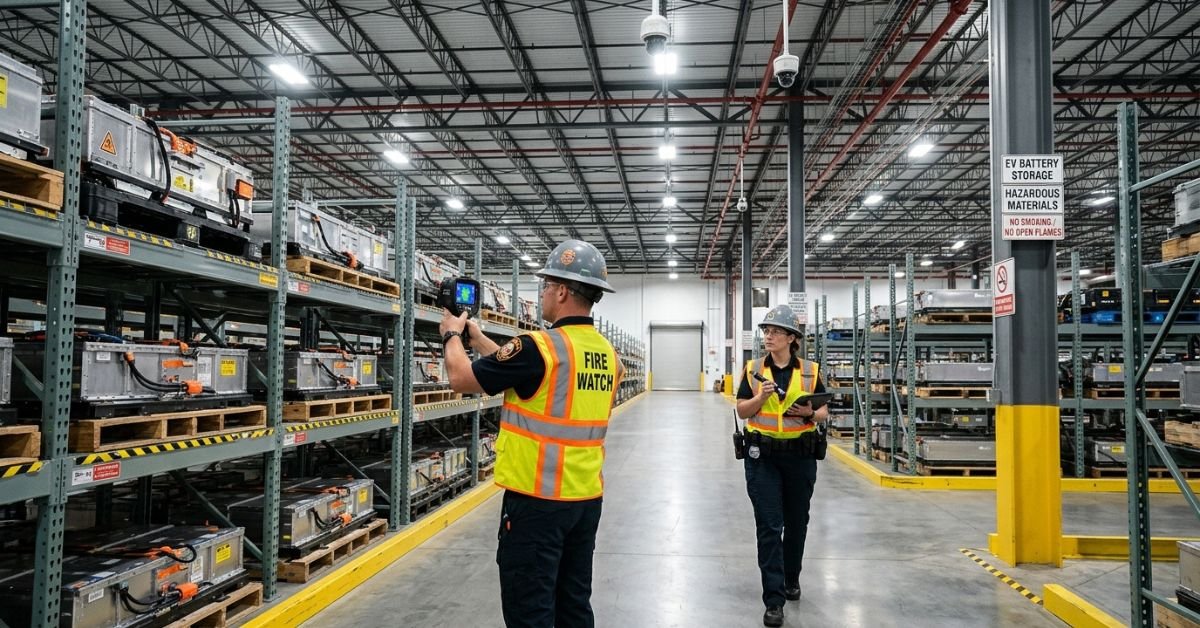
A lithium-ion pack rarely fails without warning. It warms up first, sometimes by just a few degrees. Picture a pallet of packs returned with a cracked case. Left alone, that heat can snowball into thermal runaway. That’s when one overheating cell sets off the next. Ceiling smoke detectors tend to react once flames appear. A guard with a thermal camera can spot trouble sooner. Those extra minutes leave room to act. Modern ev battery storage fire watch pairs patrols with cameras. Tools, routes, and warning levels decide its success.
Heat Shows Up Before Smoke Does
Battery failure starts small, maybe from a defect or dent. The damaged cell begins off-gassing, meaning it vents electrolyte vapor. At this stage, the casing runs 2–10°C above the room.
Nobody would feel that with a bare hand. A thermal camera spots it easily, though. That’s the window thermal patrols are built for.
What Does a Thermal Camera Pick Up?
It reads infrared energy, the invisible heat surfaces give off. Emissivity, a surface’s knack for radiating heat, varies by material. Bare copper busbars, which link modules, can read falsely cool. A strip of matte black electrical tape fixes that.
Sun-warmed pallets off a delivery truck can look alarming, too.
Patrol Routes Built Around Heat Risks
Guards pause where trouble starts:
- Charging stations get checked on every single round.
- Quarantine bays hold damaged packs, so guards linger there.
- Each stop lasts 45 to 60 seconds for steady readings.
- Rear cable channels get scanned, not just module fronts.
A FLIR E86 or Fluke Ti480 makes those stops quick.
When Should a Warm Reading Trigger Action?
Each scan gets compared with the bay’s normal temperature. The gap between them is called Delta-T. Solid ev battery storage fire watch follows a simple ladder:
- Under 5°C, the patrol continues.
- At 5–15°C, the spot gets rechecked in 10 minutes.
- At 15–30°C, a supervisor brings a gas meter.
- Above 30°C, the emergency plan starts.
Can Robots and Fixed Cameras Help Patrols?
Yes, and plenty of sites mix both in. Fixed thermal cameras on columns watch high racks around the clock. Off-gas sensors such as Li-ion Tamer flag vapor even earlier. Self-driving robots, or AMRs, roll set paths scanning aisles.
Still, a person has to confirm what the sensors flag.
A Sun-Warmed Pallet Isn’t an Emergency
Every alert on that ladder depends on one number: normal. A bay near the loading dock reads warmer in July. So does a rack beside a heater in January. Without that map, every warm reading feels like a crisis. Sites that map baselines each season stop chasing sun-warmed pallets. Guards then trust their readings, and real warnings stand out. The camera finds heat; the baseline tells guards what heat means.
FAQs
Do fire watch guards need thermography certification?
It isn’t always required, but Level 1 training helps. Guards learn emissivity, camera settings, and how to read Delta-T, and lithium-ion hazard training rounds out the skill set.
How often should thermal cameras be calibrated?
Annual calibration against a blackbody source keeps readings honest. A blackbody is a reference heater with a known temperature, and accuracy should stay within about ±2°C.
What happens to a pack that fails a scan?
Crews blanket it and move it to a quarantine spot away from the building. Guards keep scanning it for about 72 hours, since reignition can happen long after things look calm.
Which standard covers battery storage safety?
NFPA 855 is the main one for energy storage systems. The IFC and FM Global guidance add more storage rules, and local fire officials decide which editions apply.