

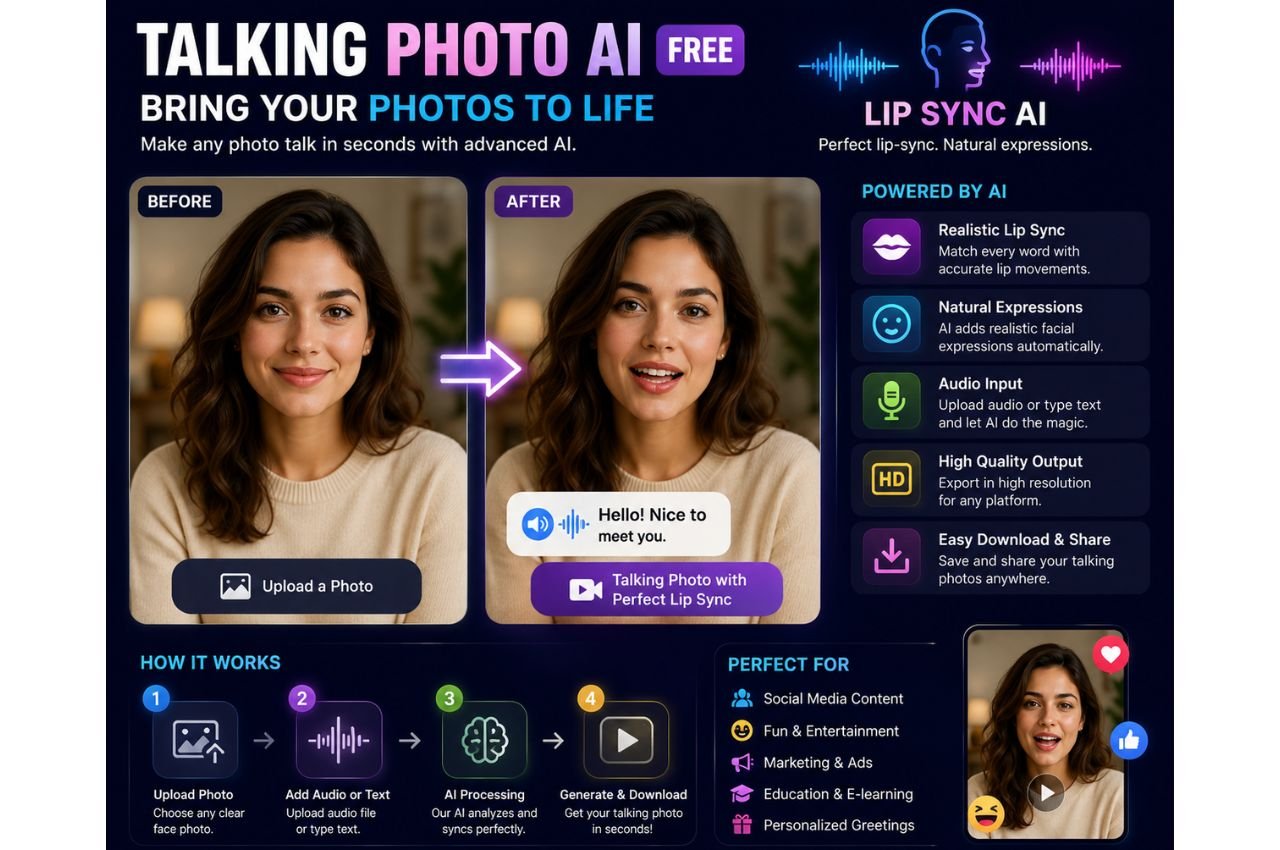
I never thought a single photograph could become a short video that actually looked like it was speaking.
For years, I treated photos as something completely static. If I wanted movement or dialogue, I assumed I would need a camera, video-editing software, and quite a bit of time.
Then I started experimenting with AI video tools.
My first test was simple: I wanted to take an ordinary portrait and see whether I could make it speak without recording a video myself. That’s how I discovered the possibilities of talking photo AI free tools.
The result wasn’t perfect, but it was good enough to make me curious.
Starting With One Photograph
I chose a clear portrait with the face looking directly toward the camera. I quickly learned that the quality of the original image matters.
A blurry picture or a face turned too far sideways didn’t produce the same natural result. Once I used a sharper photo with good lighting, the animation looked much better.
The process itself was surprisingly simple.
I uploaded the image, added the dialogue, and let the AI process it. Instead of manually creating facial movements, the software generated the animation automatically.
Watching the still face move and speak for the first time was definitely strange—in a good way.
Then I Tried Lip Sync AI
After creating a basic talking photo, I wanted to make the speech look more believable.
That’s where lip sync AI became interesting to me.
The technology attempts to synchronize mouth movements with spoken words, making the character appear to actually say the dialogue rather than simply moving randomly.
I tested a few different sentences and noticed that shorter dialogue generally produced more convincing results.
The mouth movements weren’t perfect in every frame, but the overall effect was surprisingly natural.
What Made the Biggest Difference
After several attempts, I realized that the technology wasn’t the only factor affecting the result.
The source image mattered a lot.
I got better results when:
- The face was clearly visible.
- The image had good lighting.
- The person was facing the camera.
- The photo had reasonable resolution.
- The dialogue wasn’t unnecessarily long.
I also found that natural-sounding text worked better than complicated sentences.
Where I Can Actually See Myself Using It
At first, I thought talking-photo tools were mainly for entertainment.
After experimenting with them, I realized they could be useful for many types of content.
For example, creators could turn portraits into short social media clips. A business could create a simple introduction video without recording a new presentation. Teachers could experiment with animated educational characters, while marketers could use talking visuals to make promotional content more engaging.
Even for personal projects, it’s an easy way to give an old photograph a completely different purpose.
My Favorite Part Was the Simplicity
What impressed me most wasn’t simply the animation.
It was how little technical knowledge I needed.
Traditional video production can involve cameras, microphones, lighting, editing software, and several rounds of adjustments. With AI, I could start with a single image and experiment within minutes.
That’s especially useful for someone like me who enjoys trying creative ideas but doesn’t want to spend hours learning professional editing software.
A Few Things I Would Do Differently
My first few attempts weren’t as good as I expected.
One photo had poor lighting, and the resulting face movement looked unnatural. Another image was too small, which affected the final quality.
I also learned not to make the dialogue too long.
Now I start with a high-quality portrait and a short script. If the first result doesn’t look right, I change the image or wording instead of trying to fix everything manually.
That approach gives me much better results.
My Takeaway
The biggest thing I learned from experimenting with talking photo AI free tools is that AI doesn’t necessarily need to be complicated to be useful.
A simple photograph can become an animated talking character with only a few steps.
Adding lip sync AI makes the result more convincing by matching facial movements to speech, which takes the effect beyond a basic photo animation.
I still wouldn’t expect every generated video to look completely human. Some expressions or mouth movements can occasionally look unusual. But for quick creative projects, the technology has come a long way.
Final Thoughts
I started this experiment mostly out of curiosity, but I ended up finding a surprisingly practical creative tool.
A single photograph can now become a short talking video without cameras, complicated editing software, or professional animation skills. For me, the combination of talking photo AI free tools and lip sync AI makes it much easier to experiment with ideas that I previously would have considered too time-consuming.
The technology isn’t perfect, but that’s not really the point. What matters to me is that it has made this type of content accessible enough for ordinary users to try.
And honestly, turning a completely still photograph into something that appears to speak is still pretty impressive.